

CHAPTER ONE
RED MERCY
COLORADO | 1871
They raised the town the way men raise a fence when they’re afraid of what lies beyond it, fast and upright and with no thought given to how long the posts would hold once the ground remembered itself. Wagons circled the clearin’ in a loose ring, wheels still caked with river clay and trail dust from places whose names’d already begun to rot in the mouths of the people who spoke ‘em. Canvas flapped in the dry mountain wind. Tin cups clinked. Horses stamped and rolled their eyes white at flies they couldn’t outrun. Someone’d brought a brass band from two territories over and they stood sweatin’ in their uniforms with their instruments catchin’ the sun like pieces of somethin’ stolen and bright.
They called the place Red Mercy because a preacher said it aloud durin’ the blessin’ and the word mercy struck the men listenin’ as somethin’ earned rather than given, somethin’ that could be wrested from the earth with picks and powder and enough faith to dull the scream of it. Red came later, added in quieter conversations, spoken by men with blood under their nails and gold dust in their beards. Red Mercy sounded like forgiveness that’d cost somethin’ far too valuable to forget.
The land lay there as land does, unblinkin’, its grasses cut low by boots and hooves, its soil compacted by ambition. But there was a kinda wrongness to it that made the horses uneasy and caused the dogs to whine and circle back toward their owners. The hills rose around the clearin’ in a manner that felt less like protection and more like observation, as if the town had been built in the open palm of somethin’ very old that hadn’t yet decided whether to close its fingers in death or rebellion.
They set up a rough platform from wagon boards and stacked crates and called it a stage, and when the men climbed atop it they stood taller than they’d ever stood before, chests out, hats off, faces lifted into the light as though the sky itself were an audience that might be persuaded to approve. The women gathered close, skirts brushin’, children dartin’ in and outta the legs of strangers, the sound of laughter too frequent, like glass tapped with a knife.
A man read from a proclamation written back east and carried west in a leather satchel. His voice was dry and formal and drifted over the crowd without landin’ anywhere in particular, words like territory and charter and prosperity spoken as though they were charms that could be laid across the ground to keep it from risin’ up. Applause followed at the proper moments, clappin’ loud enough to scare birds from the cottonwoods near the creek.
They swore in the sheriff last, as though law itself were the final blessin’ required to make the town real.
Elias Crowe stepped forward when his name was called, boots scuffed but polished that mornin’ outta habit rather than hope. He removed his hat and held it at his waist with both hands, fingers curled into the felt. He wasn’t a tall man but he carried himself with the straight-backed bearin’ of someone who’d learned early that posture could stand in for authority. His hair had already begun to gray at the temples despite his relative youth, and his face bore the permanent lines of someone accustomed to squintin’ into sun and smoke and uncertainty. His eyes were steady and unromantic and they moved over the crowd with a calm that wasn’t warmth and wasn’t suspicion but somethin’ between the two, an acknowledgin’ of presence without attachment.
When he placed his hand on the Bible, the leather creaked faint, dry as old skin. He repeated the oath as it was given to him, his voice even and clear, the words settlin’ into him like stones laid in a riverbed. He swore to uphold the law of a territory not yet fully mapped, to protect citizens whose claims to citizenship withered with the weather, to stand between order and whatever waited beyond it with a gun and a badge and the belief that such things still mattered out here.
The crowd cheered louder for him than they had for the proclamation, because a sheriff meant safety and safety meant permanence, and permanence was the lie everyone’d agreed to tell themselves in order to sleep at night. A woman pressed a baby into his arms without askin’ and he held the child awkward while laughter rippled through the crowd, his smile brief and strained, his eyes flickin’ toward the hills as if listenin’ for somethin’ he couldn’t yet hear.
The mine was mentioned only in passin’, as if it were an afterthought rather than the spine upon which the town had been threaded. A man with a gold bracelet spoke of it with reverence, describin’ veins and yields and the promise of steady work, his words smooth, his hands clean. He didn’t mention the laborers by name, only numbers and output and efficiency, and when he gestured toward the hills his hand made a motion like a benediction.
From where Crowe stood he could see the mouth of it, a dangerous interruption in the stone, timbers framin’ the entrance like ribs. It’d been sealed after a collapse deeper inside took men with it, already spoken of less often than it should’ve been, the openin’ boarded and tarred and marked with warnings that were more symbolic than sincere. The boards were new and the nails bright, but the rock around ‘em bore the scars of older cuts, and there was somethin’ about the way the light refused to rest there that disturbed him. The mine didn’t look ominous. It looked aware. Listenin’. Watchin’ back.
Someone fired a pistol into the air to celebrate and the sound cracked across the clearin’, piercin’ enough to make the townsfolk flinch. A cheer followed, then another shot, and then the band struck up a tune that tried real hard to sound hopeful. Whiskey appeared as if summoned, passed hand to hand in bottles that caught the sun, and the mood lifted into somethin’ close to joy.
Crowe stepped down from the platform and made his way through the crowd, acceptin’ handshakes and nods and words of congratulations that slid off him without leavin’ much behind. He noticed the way people touched him as they passed, fingers brushin’ his sleeve or his shoulder as if confirmin’ his solidity. He noticed the way they positioned themselves between him and the mine without realizin’ it, bodies unconscious, backs turnin’ toward the hills.
He paused at the edge of the clearin’ where the grass was baldin’ and the ground sloped upward, and there he felt it more clearly, a pressure that hadn’t nothin’ to do with altitude or weather. The earth beneath his boots felt compacted and strained, as though it were holdin’ somethin’ down. He bent and pressed his palm to the dirt, ignorin’ the curious looks it earned him, and for a moment he thought he felt a vibration, faint and irregular, like breath taken too slow.
He straightened and wiped his hand on his trousers, tellin’ himself it was nothin’, tellin’ himself that new towns always felt strange, that land newly named resisted the sound of it for a while. He told himself that law would conquer it, that order would press down upon the place till whatever disquiet lingered beneath was forced into submission.
As the sun slid lower and the celebration wore on, shadows lengthened in ways that didn’t match the shapes that cast ‘em. The band grew sloppy. Laughter edged into argument. Children cried from exhaustion and were carried away. Fires were lit and roastin’ meat filled the air, rich and smoky.
From the mine, far enough away that no one thought to look, there came a sound so low it barely qualified as noise at all, one that moved through the rock and into the ground and up into the soles of Crowe’s boots.
The boards over the entrance shuddered, enough to arrange more firmly into place, and then were still.
Red Mercy celebrated long into the evenin’, unaware that the ground beneath it’d already begun to remember every name it’d been forced to forget.
The fires burned down into coals and the music collapsed into a few stubborn notes blown off-key by a man too drunk to notice the offense he was committin’ against the melody. One by one the wagons fell outta sight. Canvas sagged. Laughter sank into murmurs and murmurs into the small sounds people make when they’re alone but not yet safe enough to sleep. The town loosened its grip on the day and let night take it.
Elias walked the perimeter till his feet ached, trackin’ the edge of Red Mercy as though he might learn its shape well enough to defend it. He passed new buildings already claimin’ permanence, false fronts nailed up with more confidence than skill, doors hung crooked but locked all the same. He noted where the saloon would stand once the boards were planned and painted, where the jail would go, where the church had already staked its claim on higher ground as though elevation alone implied holiness. He mapped it in his head, every street and alley that didn’t yet exist, because that was what sheriffs did. They imagined trouble before it arrived.
The stars came out hard and numerous, the kind of sky that made a man feel judged simply for standin’ beneath it. Crowe stopped again without knowin’ why and looked back toward the hills. The mine was blacker than the darkness around it, an absence that refused to be filled by night.
He felt it then with certainty, not fear exactly but recognition, the way one recognizes a scar beneath a glove. The hum hadn’t stopped. It moved steady and deep, like somethin’ thinkin’ real slow.
A shout rose from the saloon tent, laughter followin’ it, and the spell broke enough for him to breathe again. He turned away and continued his walk, tellin’ himself that unease was the natural tax of responsibility, that men given badges often imagined threats to justify the weight of ‘em.
Near the creek a group of laborers sat apart from the rest, their fire smaller, their voices lower. They spoke in a language that slid past Crowe’s ear without meanin’. They didn’t look up when he passed. Their faces were tired in a way he recognized, the exhaustion of men whose labor was considered incidental to the result it produced. He paused, considerin’ whether to greet ‘em, whether it was his place or merely his duty, and in that hesitation he felt the first true fracture in the idea of law he carried with him.
By the time he decided, they were already packin’ up, movin’ back toward the hills in a loose line, lantern light bobbin’ like cautious stars. He watched ‘em go till the dark swallowed ‘em whole.
The wind changed after midnight, comin’ down off the rock with a chill. It threaded through the town and worried at loose boards and canvas seams, carryin’ with it a faint sound that might’ve been singin’ if one were inclined to kindness, or might’ve been breath movin’ through a narrow place. Crowe stood in the street and listened till his teeth ached from clenchin’.
From the mine there came a settlin’ sound, not loud enough to wake anyone but him, an accommodation of weight and space. The boards over the entrance bowed inward, respondin’ to pressure from behind. Dust shook loose and drifted down in a fine cloud that caught the starlight before vanishin’.
Elias rested his hand on the butt of his pistol without drawin’ it, an old reflex from a life lived elsewhere, and felt foolish for the comfort it offered him. Whatever lay beyond those boards didn’t recognize steel or powder or the authority stamped into a piece of tin. He knew that as sure as he knew his own name, though he couldn’t yet have said why.
A dog began to howl at the far edge of town, the sound high and unrelentin’. It was joined by another, then another, till the noise stitched itself together like a wound that wouldn’t close.
Elias walked back toward his quarters as dawn’s idea began to form somewhere beyond the hills, pale and reluctant. It was already behind his eyes, an image burned there not by light but by absence.
The town slept poorly that first night, though no one would’ve said so in the mornin’. They woke stiff and hungover and full of plans, convinced that the worst thing the land could do’d already been done and survived. A mule tied near the trough went still all at once, then let out a low, strangled sound like it’d been startled from the inside. The mine sat sealed and silent, exactly as it was meant to be.
Below it, far beneath the reach of nails and prayers and proclamations, somethin’ listened and waited, countin’ not time but names, and findin’ the number still unfinished.
Mornin’ came to Red Mercy like a compromise struck between light and reluctance. The sun rose over the hills, as if it too were unsure about layin’ eyes on what had been built overnight. Frost clung to the grass in white patches that melted quick beneath boot soles, leavin’ the ground damp, the kind of soil that held onto footprints longer than it ought to. Smoke crept up from cookfires rekindled without ceremony, the smell of coffee and salt pork driftin’ low through the streets that had not yet learned their own names.
Elias Crowe woke before the bell they had hung from a crossbeam near the center of town. He lay still on his narrow cot, starin’ up at the rough planks overhead, listenin’ to the town come back into itself. Wood popped as it warmed. A horse snorted. Somewhere a man coughed wet and deep, the sound of it lingerin’ like a warnin’. Crowe swung his legs over the side of the bed and sat there a moment longer than necessary, his boots waitin’ on the floor like they knew what was comin’.
He washed his face in cold water and watched the dust swirl in the basin, the grit settlin’ into shapes that reminded him of nothin’ in particular and therefore everythin’. He pinned his badge to his shirt with care, feelin’ the small familiar weight of it settle against his chest. It didn’t feel earned yet. It felt borrowed.
Outside, the town looked different in daylight, stripped of the night’s soft lies. The buildings leaned worse than he remembered. The street was narrower. The hills pressed closer. What had felt like promise yesterday now carried the faint air of somethin’ provisional, like a camp folks pretended was a home because sayin’ otherwise invited fear.
Men gathered in loose knots, talkin’ low, glancin’ now and then toward the hills without knowin’ they were doin’ it. Women moved with purpose, their voices already weary in a way that suggested sleep had offered ‘em little comfort. Children ran and shouted and then stopped sudden, standin’ still as if listenin’ for somethin’ only they could hear, before shakin’ it off and runnin’ again.
Crowe made his way toward the center of town, noddin’ where nods were expected, answerin’ questions he had no answers for with a demeanor he wielded like a trade. He paused near the creek and watched the water movin’ over stone, clear enough to show the bottom but not clear enough to promise safety.
A man approached him there, hat in hand, eyes dartin’. He spoke of nothin’ in particular, asked about patrols and curfews and whether Crowe thought the land was safe now that a sheriff had been sworn. Crowe answered him with the words folks wanted, talk of order and vigilance and the natural settlin’ pains of a new place. The man nodded too quick, thanked him too much, and hurried off like he had asked a question he had not truly wanted answered.
Near the edge of town, Crowe saw the boards of the mine catch the light for the first time that day. The tar had dried uneven, leavin’ streaks that looked like old runoff, like somethin’ had already tried to escape and failed. He found himself walkin’ that direction without rememberin’ makin’ the choice, his boots carryin’ him up the slight incline, the air growin’ cooler with every step.
He stopped short of the entrance, close enough to smell the pitch, close enough to see where the boards bowed a touch inward. He reached out and pressed his palm flat against the wood. It was colder than it ought to be. Cold, as if the warmth of the sun couldn’t find its way there.
Behind him, footsteps crunched on gravel. Crowe turned to see a boy, no more than ten, standin’ a few paces back with a sack slung over his shoulder. The boy stared at the mine with open dislike, his mouth set hard.
“You hear it too,” the boy said, not askin’.
Crowe considered him a moment before answerin’. “Hear what?”
The boy shrugged, eyes never leavin’ the boards. “Like singin’. But it ain’t nice singin’.”
Crowe felt a chill slide down his back that had nothin’ to do with the air. He asked the boy who he belonged to. The boy named a man Crowe recognized from the ceremony, one of the ones who had cheered loudest. Crowe told him to head back to town and stay near his folks, told him the mine was closed for a reason. The boy nodded but didn’t look convinced. When he left, he went quick, like he feared lingerin’ would cost him somethin’.
Crowe stood there a while longer, listenin’. There was no melody or rhythm, only that same deep pressure he had felt the night before, like the earth holdin’ its breath. He stepped back at last and forced himself to turn away. He drove a boot hard into the dirt, markin’ the spot like it mattered, like it could be returned to. “Closed means closed,” he muttered, more to the ground than himself.
By midday the town was fully awake, work begun in earnest, hammers ringin’, saws bitin’, voices raised in argument and instruction. The illusion of normalcy crept in, weak but serviceable. Crowe walked the streets again, markin’ faces, learnin’ names, notin’ who avoided his gaze and who sought it too eagerly.
Near where the saloon would stand, he noticed a woman leanin’ over the counter, her buxom breasts plungin’ outta her corset as she scrubbed the counter, watchin’ the flow of people like she was takin’ inventory. She had raven hair pulled back loose, curls escapin’ to frame a face that knew how to keep its own counsel. When she smiled at a man passin’, it was easy. When she looked at Crowe, the smile didn’t come.
Juniper Bell watched him like she had already decided somethin’ and was waitin’ to see if he would confirm it.
“Mornin’, Sheriff,” she said, her voice carryin’ a drawl that softened the word without dullin’ it.
“Mornin’, Miss Bell,” Crowe said. He hadn’t asked her name.
She tilted her head, studyin’ him too long before speakin’, like she was decidin’ whether he was worth the trouble. “You walk like a man listenin’ real hard.”
Crowe didn’t deny it. “How you findin’ the town?”
She laughed once, low. “Like it’s sittin’ on a secret. Like most places built too fast.”
She pushed off the post and stepped closer, lowerin’ her voice. “Folks talk when they drink. They talk when they think nobody important’s listenin’.”
She glanced toward the hills. “They talk about that mine like it’s a church. Churches got ghosts too, last I checked.”
Crowe held her gaze. He saw no fear there, only caution sharpened into somethin’ like interest.
“You hear things at night,” she went on. “Men sayin’ they dreamt wrong. Wakin’ up tired. Like they been workin’ while they slept.”
Crowe nodded. “I’ll keep it in mind.”
She smiled then, small and knowin’. “Ain’t nothin’, Sheriff. Figgered you’d wanna know what folks won’t say out loud.”
As the day wore on, clouds gathered over the hills, gray without threat of rain. The light dimmed in a way that made colors look bruised. Crowe found himself thinkin’ again of the laborers he had seen the night before, the way they had moved off together without sound. He asked around about ‘em, got answers that slid sideways, numbers instead of names, shrugs where there ought to have been memory.
By evenin’, the hum returned, faint but insistent, felt more than heard. It threaded through the town like a pulse, settlin’ into walls and bones alike. Crowe stood in the doorway of the unfinished jail and watched the mine as the light faded, watched the boards shiver once, barely, adjustin’ itself in sleep.
He knew then that Red Mercy had not been born so much as scraped free of the dirt enough to breathe again. He knew that whatever lay beneath the mine had already marked the town as its own.
The wind came up as night fell, carryin’ with it the smell of stone and somethin’ dyin’, and Elias Crowe stood his ground and listened, while beneath his feet the earth waited for the rest of the names it was owed.
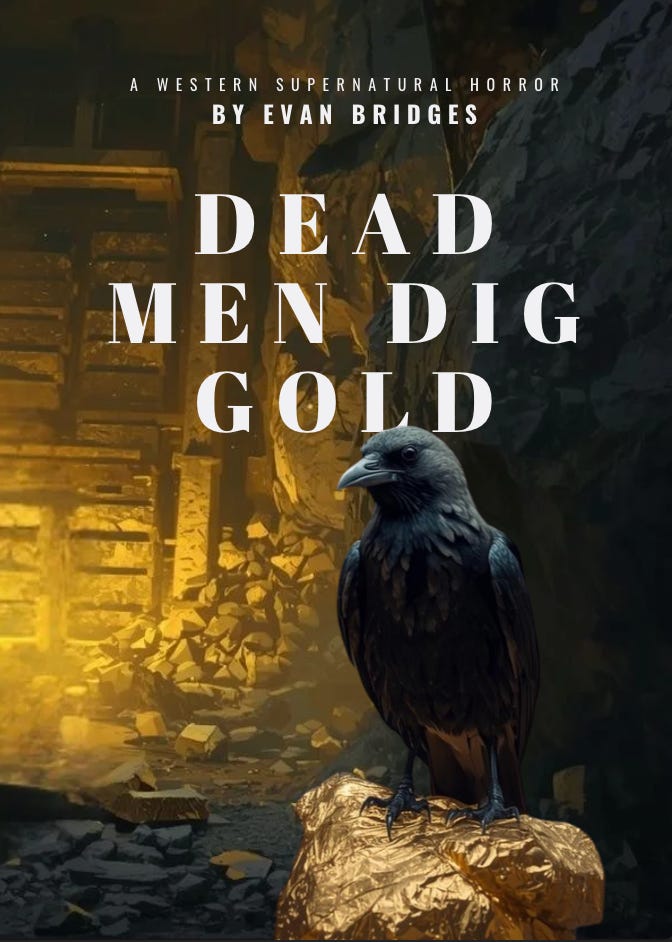
Dead Men Dig Gold is my debut novel.
Thank you so much for reading.
I will be posting new chapters every Friday, subscribe to follow along.©️ 2026 Evan Bridges
For rights questions contact: evanbridgesauthor@gmail.com
I’m so proud of you ❤️