

CHAPTER FIVE
FALSE HISTORY
Elias Crowe started with the men who liked bein’ remembered.
They sat in offices filled with ink and old paper and unearned confidence, boots propped where boots ought not be, hats hung on pegs like symbols rather than tools. These were the founders, the men whose names’d already been carved into ledgers and spoken aloud at the ceremony with a reverence that bordered on prayer. Men who’d arrived early enough to pretend the land had been waitin’ for ‘em.
Crowe took each visit slow, holdin’ no accusation. He asked questions the way a man asks about weather, casual and open, lettin’ the answers tell him what the speaker thought important. When’d the mine been struck. Who’d financed it. How many men’d worked it at peak. How long before the collapse. How bad it’d been.
They answered easy at first. Gold makes men generous with memory so long as it flatters ‘em.
They spoke of luck and vision and grit. Of takin’ risks when others’d turned back. Of bringin’ civilization where there’d been nothin’ but rock and sage and silence. They spoke of opportunity as if it were a thing they’d discovered rather than somethin’ they’d seized.
When he asked about the collapse their voices changed, deep like boards worn down by weather. They shrugged. Accidents happened. Rock shifted. Timber failed. A regrettable business but no one’s fault. Mines were dangerous by nature. Everyone knew that goin’ in.
Crowe nodded. Wrote it down.
When he asked how many’d died, they all gave him the same answer though none of ‘em spoke it quite the same way.
Not many.
Minimal casualties.
A handful at most.
The records bore it out. Ledgers neat as hymnals. Dates. Costs. Delays. Repairs. A brief notation markin’ the collapse and another notin’ the sealin’ of the shaft for safety reasons. Names listed beneath were short. Too short.
Crowe thanked ‘em polite and left.
He walked the streets afterward, boots stirrin’ dust that’d already begun settlin’ into the grooves of the town like it’d always been there. The buildings looked more permanent by the day. Paint dried. Signs went up. The lie of stability took firmer hold.
He did not feel relieved.
By the time the sun dipped low he’d spoken to six men and every one’d told the same story with the same omissions. They’d not rehearsed it together. That was what troubled him most. A rehearsed lie shows seams. This was somethin’ older, smoother, worn down by repetition until it passed for truth.
That night he went to the saloon.
It was near finished now, walls up and roof set, the smell of fresh-cut wood fightin’ with whiskey and sweat. Juniper Bell stood behind the bar, sleeves rolled, hair pinned up careless, eyes trackin’ the room without ever seemin’ to look. She slid him a drink without askin’. He took it without thankin’. The two of ‘em fell into a rhythm that felt familiar despite its youth.
He didn’t start with the mine.
He asked about the men he’d spoken to. Asked who drank the most. Who talked when they shouldn’t. Who’d gone quiet since the collapse.
Juniper leaned her elbows on the bar and smiled like she’d been waitin’ for the question.
“They don’t tell it the same way in here,” she said.
He looked at her then, really looked, and saw the tension livin’ beneath her skin, the way her fingers worried the edge of the bar when she thought no one was watchin’.
She poured for a man two stools down, then leaned back in toward Crowe, voice lower.
“In here it’s worse.” She said it like it was a weight she’d set down too many times already.
“Folks heard things after the collapse. Not the crash. What came after. Knockin’. Shoutin’. Singin’.”
She leaned closer. “They sealed it while you could still hear ‘em.”
Crowe felt somethin’ in his chest tighten, a pull like a knot drawn too tight.
“How many?” he asked.
Juniper shrugged. “Depends who you ask. Some say dozens. Some say more. Some say nobody knows because nobody counted.”
She wiped the bar with a rag that’d long since lost the ability to clean anythin’. “They weren’t written down proper. Names don’t carry if nobody wants ‘em to.”
He drank. The whiskey burned wrong goin’ down.
“Why tell me?” he asked.
She met his eyes then, direct as a knife laid flat.
“Because you’re the only one listenin’.”
The saloon buzzed around ‘em, laughter and lies and relief stacked over smoke.
Outside, beyond the walls and the light and the sound of men pretendin’ tomorrow’d be like today, the mine sat sealed, holdin’ its truth the way the earth holds bones, not outta mercy but because it knows time will do the tellin’ for it.
The night didn’t answer him. It waited, same as the earth always had, same as it always would.
He went back to his office after that, pulled the ledger from its shelf, laid it open beneath the lamp. He traced the lines again, the numbers, the gaps where names should’ve been. He thought of the laborers by the creek on the first night, how they’d kept their distance, how they’d moved back toward the hills without lookin’ at him. He wondered how many of ‘em knew exactly what lay sealed behind those boards, how many had kin buried there without marker or prayer.
Crowe took out a fresh sheet of paper and began writin’ his own list, not numbers but questions.
“Who ordered it sealed? Who signed the papers? Who profited after?”
He wrote until his hand cramped and the lamp burned low, until the questions began to blur into somethin’ else, somethin’ that felt less like investigation and more like accusation.
Near dawn he stepped outside again, drawn by that same pressure he’d felt since the town’s birth. The air was cold and thin, breath steamin’ faint. He walked toward the mine road, boots crunchin’ over gravel, every sound too loud in the quiet.
Halfway there he stopped. He could hear it now, clearer than before. Work sounds, carried up through earth that remembered the shape of hands.
Crowe stood there and listened, the law suddenly feelin’ small against the weight of what had been done in its name. He thought of the oath he’d taken, the words laid in him like stones, and wondered what kind of justice could reach men already dead, men denied even the dignity of bein’ counted.
The sound went on, steady and unhurried, as if whoever made it had all the time left in the world.
Crowe turned back toward town, jaw set, mind burnin’ with a certainty that left no room for comfort. The history of Red Mercy was a lie told cruel and quiet, but lies had a way of leavin’ residue, and this one had soaked deep into the ground.
Behind him, beneath the boards and the tar and the prayers nailed shut with ‘em, the mine held its dead close and listened.
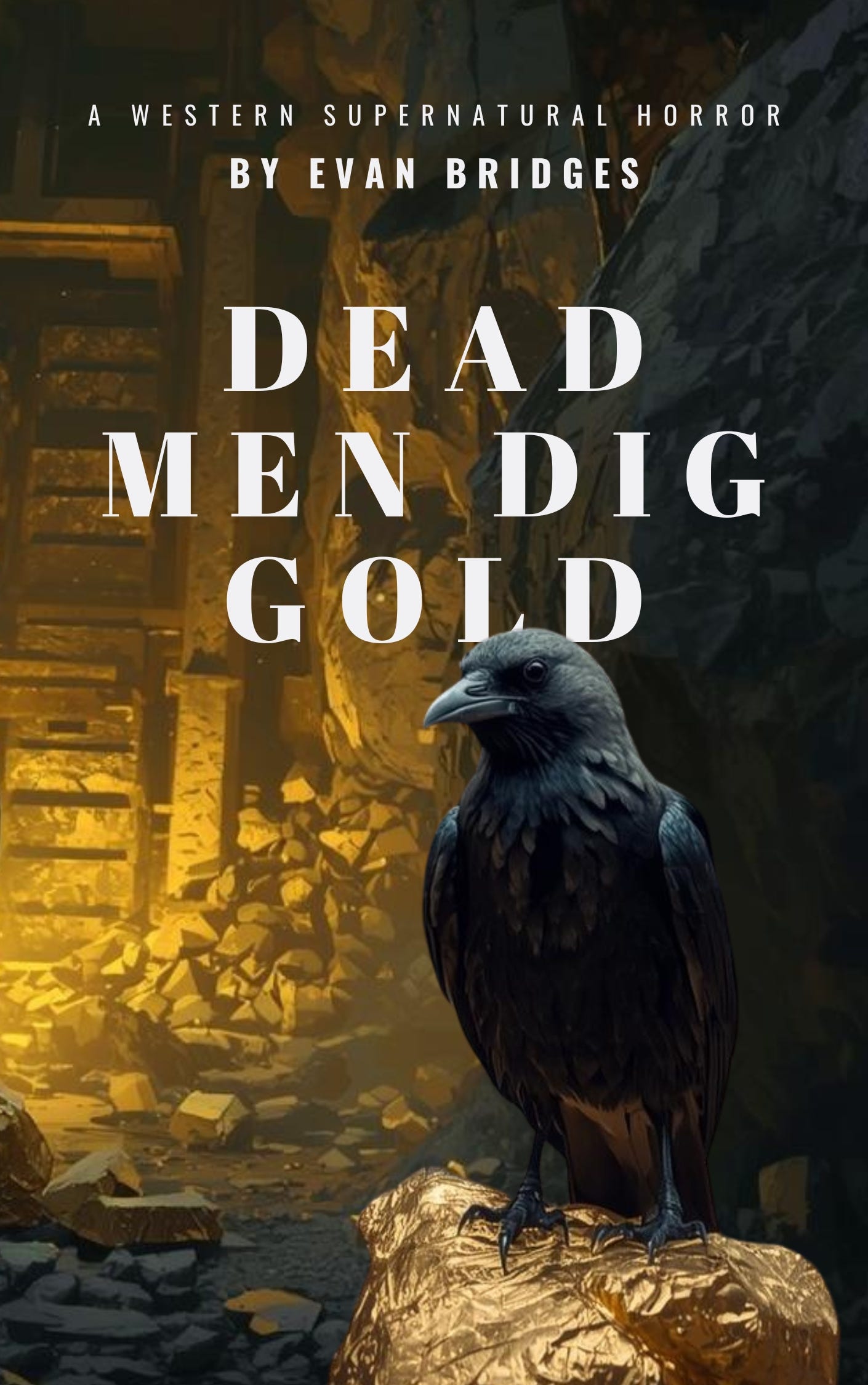
Dead Men Dig Gold is my debut novel.
Thank you so much for reading.
I will be posting new chapters every Friday, subscribe to follow along.©️ 2026 Evan Bridges
For rights questions contact: evanbridgesauthor@gmail.com
Every town writes two histories.
The first is carved into monuments.
The second is buried beneath them.
The second one is usually true.
Filed under: Things Buried, Not Gone.
A remarkable reminder that forgotten is not the same thing as lost.
—The Archivist
I really enjoyed this!